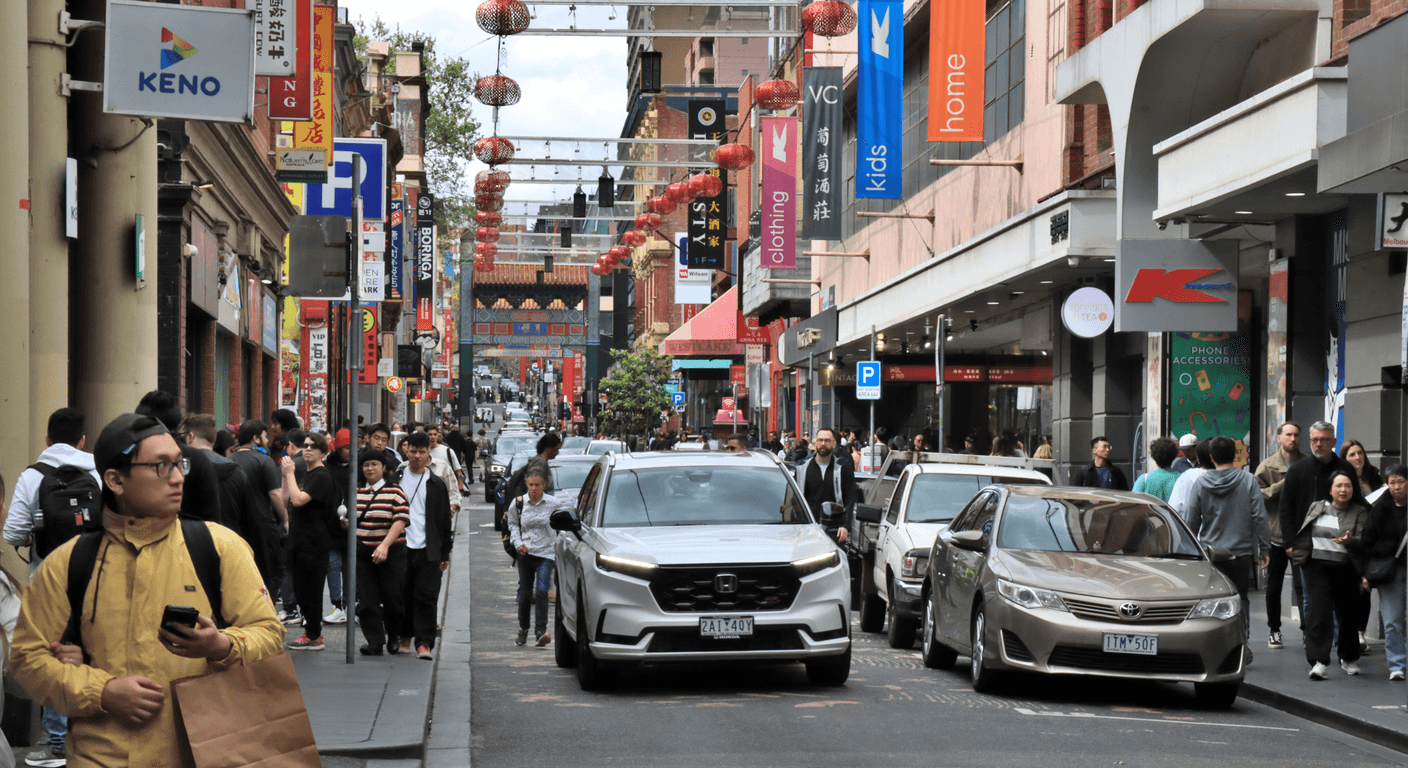
Melbourne's Chinatown on Little Bourke Street is the oldest continuous Chinese settlement in the Western world, and it rewards a slow, curious day. This guide takes you through the heritage buildings, the best dumpling houses for a solo lunch, the Chinese Museum, and the surrounding laneways — all at a pace that suits a traveller who prefers to savour rather than rush.
Why Melbourne's Chinatown suits a solo day out
There is something particularly satisfying about a neighbourhood that has been doing the same thing well for over 170 years. Little Bourke Street's Chinatown has been continuously occupied by Chinese community businesses and families since the 1850s gold rush — making it the oldest continuous Chinatown in the Western world, a fact that tends to stop people in their tracks when they first hear it. For a solo traveller who appreciates depth over novelty, that history gives the whole street a different quality.
The precinct is compact and walkable, which suits a day that is meant to be pleasurable rather than exhausting. Everything worth seeing sits within roughly four or five blocks, and the flat terrain of the central city means there are no significant gradients to contend with. For anyone who prefers to move at a considered pace, that is a genuine advantage.
There is also a particular ease to eating alone here. Dumpling houses and yum cha restaurants are accustomed to solo diners, and a seat at a shared table or a small window perch is never awkward. Nobody is hurrying you, and the food arrives quickly enough that you are never sitting idle with nothing to do.
Getting there: the free tram and where to alight
The simplest way to reach Chinatown from anywhere in the central city is on the free tram network. Melbourne's Free Tram Zone covers the CBD grid and extends along Spring Street, Flinders Street, Spencer Street, and La Trobe Street — meaning the entire Chinatown precinct falls comfortably within it. You do not need a Myki card if you are travelling entirely within the zone, though it is worth having one loaded if you plan to travel beyond the CBD at any point in the day.
Tram routes 86, 96, and several others run along Bourke Street Mall and stop close to the eastern end of the city grid. From the Bourke Street Mall tram stop, it is a short, flat walk of around four minutes north along Swanston Street to the corner of Little Bourke Street. The iconic ceremonial gates — red and gold, donated by the Chinese government — mark the entrance to the main Chinatown precinct and are hard to miss.
If you are arriving by train, Melbourne Central Station on the corner of La Trobe and Swanston streets puts you at the northern edge of the precinct in under five minutes on foot. Flinders Street Station is a slightly longer walk of around ten minutes but is entirely flat. Check current tram routes and any service changes at ptv.vic.gov.au before you travel.
The history you are walking through
It is easy to walk down Little Bourke Street and simply look for a menu board, but the street repays a slower read. The buildings that line it — many of them Victorian-era terraces with later Chinese architectural detailing added to facades — tell the story of a community that survived the White Australia Policy, the xenophobia of the gold rush era, and successive waves of economic pressure, and still maintained a continuous cultural and commercial presence. That is not a small thing.
The Chinese arrived in Victoria in significant numbers from the early 1850s, drawn by the Ballarat and Bendigo goldfields. When the diggings became hostile and legislatively exclusionary, many moved to Melbourne and established businesses along Little Bourke Street — laundries, produce merchants, cabinet makers, and herbalists. The street never fully left that identity. By the time of Federation and the formal introduction of the White Australia Policy, the community here was already too established and too economically embedded to be entirely displaced.
Walking the street with that knowledge changes what you see. The clan association buildings, the Buddhist and Taoist temples tucked above shopfronts, and the older grocery stores are not just atmosphere — they are evidence of persistence. The Chinese Museum, at 22 Cohen Place just off Little Bourke Street, is the best place to sit with that history properly, and it is worth going there before lunch rather than after, so the meal that follows feels more considered.
The Chinese Museum: what to expect and how long to allow
The Chinese Museum is a genuine cultural institution, not a tourist attraction dressed up as one. It occupies a heritage building in Cohen Place, a short laneway off Little Bourke Street, and its permanent collection covers the history of Chinese Australians from the goldfields era through to the present day. The Dai Loong dragon — one of the largest ceremonial dragons in the world, at over 100 metres long — is housed here and is alone worth the entry price for anyone with any interest in Chinese cultural tradition.
Allow between 90 minutes and two hours if you want to move through the galleries properly. The museum is not enormous, but the content is dense and thoughtful, and it would be a shame to rush it. Entry is around $15–$18 for adults at the time of writing, though you should confirm current pricing directly at chinesemuseum.com.au before visiting, as costs do change.
Accessibility is reasonable but worth noting honestly. The main gallery levels are accessible by lift, but some areas of the older building have narrower corridors and uneven flooring. If you use a walking stick or have balance concerns, the layout is manageable with care. Staff are generally attentive and helpful. There are seating areas within the galleries, which makes a real difference for anyone who tires easily on their feet.
Dumplings and yum cha: eating well as a solo diner
The best time to have yum cha or dumplings in Chinatown as a solo visitor is between 11am and noon. The big yum cha houses — places like Shark Fin House on Little Bourke Street and HuTong Dumpling Bar on Market Lane — are considerably quieter before the midday rush, and staff have more time for you. By 12.30pm on a weekend, the larger restaurants can be genuinely loud and the wait for a table can stretch past 30 minutes. Going early is simply better eating.
For yum cha, a solo sitting at one of the round tables usually means being joined by another group eventually, which is perfectly normal and often pleasant. A reasonable yum cha lunch — three or four dishes of har gow, siu mai, cheung fun, and a pot of jasmine tea — will come to roughly $25–$35 per person at most Chinatown establishments. These are indicative figures only; always confirm current pricing with the venue.
For dumplings specifically, the laneways off Little Bourke Street — particularly Market Lane and Celestial Avenue — have smaller, less formal eateries where a bowl of soup dumplings or a plate of pan-fried pork and chive dumplings will cost around $14–$18. These smaller venues are often easier for solo diners because the tables are smaller and the environment is less hectic. If you have dietary requirements, it is worth calling ahead, as not all venues handle this equally well.
The laneways around Chinatown: where to walk after lunch
Melbourne's laneway culture is one of the genuine pleasures of the central city, and the streets around Chinatown connect into some of the best of it. After lunch, a walk east along Little Bourke Street and then south down one of the small lanes towards Bourke Street takes you past herbalist shops, small Buddhist goods stores, and the occasional beautifully maintained clan association building. These are not tourist reconstructions — they are working parts of the community.
Tattersalls Lane and Celestial Avenue are worth particular attention. Celestial Avenue, which runs between Little Bourke and Bourke streets, has a strong laneway food and bar culture in the evenings but is quieter and more pleasant to walk in the early afternoon. The scale of these lanes — narrow, slightly shadowed, with older brick and render above shopfronts — is a marked contrast to the wide boulevards of the main grid, and most people find them genuinely charming.
From the eastern end of Little Bourke Street, it is also a short walk to the State Library of Victoria on Swanston Street, which makes an excellent afternoon stop if you want to sit quietly, use the amenities, or simply rest in one of the reading rooms. The library is free to enter, fully accessible, and has good seating throughout. It is one of the more underused options for older travellers who want a civilised pause in the middle of a city day.
Practical matters: accessibility, pacing, and what to bring
Little Bourke Street itself is a standard Melbourne city street with kerb cuts at intersections and mostly flat footpaths. The main accessibility consideration is the laneways, which can have older, slightly uneven bluestone or brick paving — manageable with sensible footwear but worth being aware of if you use a walking frame or have significant balance issues. Comfortable, flat shoes with good grip are the right choice for this day.
Public toilets in the Chinatown precinct are limited. The most reliably accessible options are inside the Melbourne Central shopping centre on La Trobe Street (a short walk north) or within the State Library of Victoria. Most of the restaurants have facilities for customers, and the Chinese Museum has toilets available to visitors. It is worth planning around these rather than assuming you will find a public facility easily on the street.
In terms of pacing, a comfortable version of this day — free tram in, Chinese Museum, early lunch, a laneway walk, and a rest at the State Library before heading home — fits naturally into a 10am to 3pm window. That is five hours of gentle activity with built-in sitting time, which most people find sustainable without feeling rushed or overtired. If you want to extend the day, the Bourke Street Mall and the Block Arcade are both within easy walking distance for an afternoon browse.
Key takeaways
- Melbourne's Chinatown on Little Bourke Street is the oldest continuous Chinatown in the Western world, with origins in the 1850s gold rush.
- The entire precinct falls within Melbourne's free tram zone, so central city travel costs nothing if you stay within the CBD grid.
- Arriving for yum cha or dumplings between 11am and noon means shorter waits, quieter rooms, and more attentive service.
- The Chinese Museum in Cohen Place covers 170 years of Chinese Australian history and houses one of the world's largest ceremonial dragons — allow 90 minutes to two hours.
- The laneways around Chinatown — particularly Celestial Avenue and Tattersalls Lane — are best explored on foot after lunch, when the midday rush has passed.
- The State Library of Victoria, a short walk from Chinatown, is a free, fully accessible, and comfortable place to rest mid-afternoon before heading home.
Where to look and book
Indicative prices only — always confirm with the operator before booking.
Frequently asked questions
Is Melbourne's Chinatown really the oldest in the Western world?
Yes. Little Bourke Street's Chinatown has been continuously occupied by Chinese community businesses and residents since the 1850s gold rush, making it the oldest continuous Chinatown in the Western world. The Chinese Museum documents this history in detail.
How do I get to Chinatown on the free tram?
Melbourne's Free Tram Zone covers the entire CBD grid, and Chinatown on Little Bourke Street sits within it. Trams along Bourke Street Mall stop close to Swanston Street, from where it is a four-minute flat walk north to the Chinatown gates. No Myki card is needed within the free zone. Check ptv.vic.gov.au for current routes and any service changes.
What is the best time for a solo diner to visit Chinatown for yum cha?
Arriving between 11am and noon is the most comfortable time for a solo diner. The large yum cha restaurants are noticeably quieter before the midday rush, wait times are shorter, and the experience is generally more relaxed. By 12.30pm on weekends, popular venues can be busy and loud.
Is the Chinese Museum accessible for visitors with mobility considerations?
The main gallery levels of the Chinese Museum are accessible by lift, but some areas of the older building have narrower corridors and uneven flooring. It is manageable for most visitors who use a walking stick and take care, but it may present challenges for those using a walking frame. Staff are generally helpful. Confirm current access arrangements directly with the museum at chinesemuseum.com.au.
How much should a solo visitor budget for a Chinatown day?
As a rough, indicative guide: Chinese Museum entry is around $15–$18, a yum cha or dumpling lunch is roughly $25–$35, and tram travel within the free zone is free. A comfortable day out — museum, lunch, and a laneway walk — might cost around $40–$55 in total, not including any shopping or additional food. Always confirm current prices with venues and the museum directly.
Got a tip, a price update or a story from this route? The community would love to hear it.
Share your views on our Facebook page— Seniors and Solo Traveller Stories
More melbourne
A Couple's Slow Day in Melbourne's Gardens and Markets: How to Spend Almost Nothing
A gentle, low-cost day out in inner Melbourne built around free gardens, cheap market eating and easy public transport…
A Day Out With the Girls in Melbourne's CBD: Free Galleries, Cheap Eats and Easy Trams
A practical plan for a group of friends over 60 to enjoy Melbourne's inner city on a budget: free galleries, the NGV,…
A Solo Winter Day in Melbourne's CBD: Free Galleries, Warm Corners and Quiet Pleasures
A practical, gentle plan for spending a winter day alone in Melbourne's inner city without spending much. It covers fr…