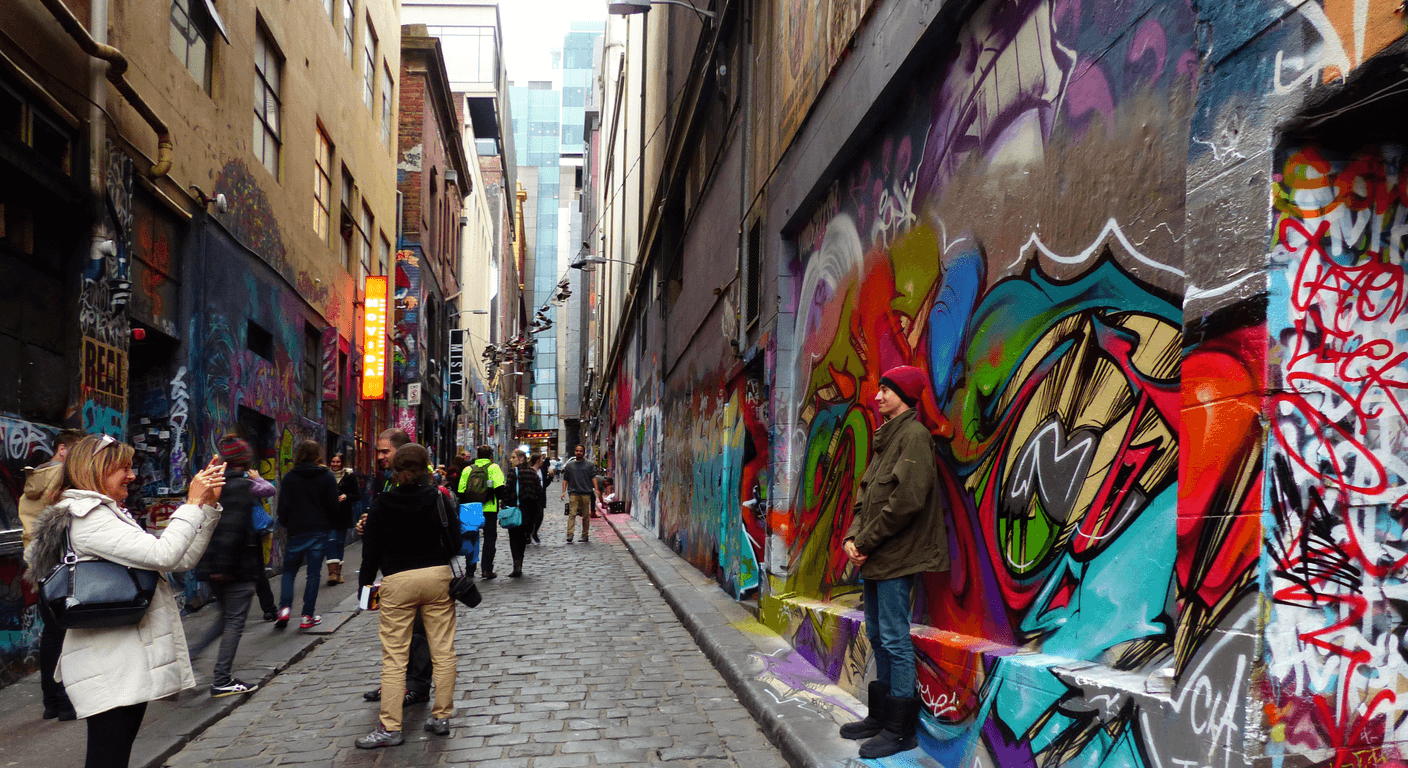
Melbourne's CBD laneways pack a surprising amount of culture, history, and good coffee into a compact, mostly walkable loop. This guide is written for the solo traveller in their 60s or 70s who wants a full day in the city without rushing — taking in Hosier Lane's street art, the historic arcades, and a rooftop drink at the end of the afternoon. Practical detail on the free tram, cobblestone realities, and where to sit down and rest is woven throughout.
Why the laneways suit a slower, solo pace
Melbourne's laneways have a reputation for being the preserve of twenty-somethings hunting the next flat white. That reputation is only partly deserved. The network of narrow streets, covered arcades, and semi-hidden courtyards between Swanston, Elizabeth, Flinders, and Bourke streets is genuinely compact — the whole loop described here covers roughly two to three kilometres of walking — and it rewards anyone who moves at a measured pace and actually looks at things.
For a solo traveller in their late 60s, there is real pleasure in having no-one to negotiate with. You stop when something catches your eye. You linger over a second coffee. You duck into an arcade because the ceiling looks interesting. The laneways are built for that kind of unhurried attention. Weekday mornings, roughly nine until midday, are the calmest window — foot traffic is lighter, cafes have seats, and the street art catches the best northern light.
The day described here is loosely structured as a loop: arrive by free tram, begin at Hosier Lane, work through the coffee laneways, pass through the historic arcades, and finish with a rooftop drink before the early-evening tram home. Nothing is timed to the minute. If you want to spend an hour in one spot and skip another entirely, the guide still holds together.
Getting there: the free tram and where to board
The CBD Free Tram Zone covers the entire loop described in this guide, which means a day in the laneways costs nothing in transport. The boundary runs roughly along Spring Street to the east, Flinders Street to the south, Spencer Street to the west, and La Trobe Street to the north. Any tram running within those boundaries is free — no myki required. The City Circle tram (Route 35) is the most visitor-friendly option, running a dedicated loop around the CBD perimeter with stops announced clearly. Check current stop locations and frequencies at ptv.vic.gov.au before you travel, as infrastructure works occasionally shift stops.
From regional Victoria, V/Line trains arrive at Southern Cross Station on Spencer Street, which sits inside the free tram zone. From the eastern suburbs, Flinders Street Station at the corner of Flinders and Swanston is the most useful arrival point — it places you one short walk from Hosier Lane and the start of this loop. Low-floor trams operate on several CBD routes, but not all; if step-free boarding matters to you, check the PTV journey planner for accessible options on the day.
Parking in the CBD is expensive and the streets around the laneways are not designed for cars. If you are driving in from outer suburbs, consider parking at a train station on a metropolitan line and continuing by train. Myki cards are available at Southern Cross and Flinders Street stations if you need one for the suburban leg.
Hosier Lane: street art and an honest word about cobblestones
Hosier Lane runs between Flinders Street and Flinders Lane, one short block east of Swanston Street. It is Melbourne's most photographed laneway, and for good reason — both walls are covered floor to roofline in layered street art that changes constantly. Established artists work alongside newer names, and the quality of the work is generally high. There is no entry fee and no guided tour required, though walking tours of the broader laneway precinct do operate and are worth considering if context and history interest you.
The cobblestones are the one honest caveat. Hosier Lane's bluestone sets are original and uneven. They are manageable at a slow pace in flat, supportive shoes — not appropriate for anything with a heel or a thin sole. If you use a walking stick, the stones are navigable but require attention. A mobility scooter or wheeled walker would find the surface genuinely difficult. The laneway is short enough that most people can assess the footing from the Flinders Street end before committing. Early morning is the quietest time; by midday on weekends it can be crowded enough that navigation becomes harder.
Rutledge Lane, which runs parallel to Hosier on its southern side, is worth a look as well — it receives less foot traffic and the art tends toward larger-scale pieces. AC/DC Lane, a short walk west near the corner of Flinders Lane and Exhibition Street, is another named laneway with a different character: narrower, darker, and associated with Melbourne's live music history. The cobblestones there are similarly uneven.
Coffee country: Centre Place, Degraves Street, and where to sit
From Hosier Lane, the walk west along Flinders Lane or Flinders Street brings you to the cluster of narrow laneways that made Melbourne's coffee reputation: Degraves Street and Centre Place, both running between Flinders Street and Flinders Lane, parallel to each other and separated by about one city block. These are the laneways you have seen in photographs — tight, European in feel, lined with small cafe tables and chalk-board menus.
Centre Place is narrower and slightly less trafficked than Degraves. Both offer espresso-based coffee from independently owned cafes at prices that are, indicatively, around four to six dollars for a flat white or long black — confirm current prices at the counter, as costs across Melbourne's specialty coffee scene have shifted in recent years. The seating at most of these cafes is on small stools or low chairs at narrow tables, which can be uncomfortable for anyone with hip or knee stiffness. It is worth looking for a spot with a standard-height chair before ordering. The cafes inside the arcades (described below) often have more comfortable seating.
If you want a quieter coffee with good natural light and a proper chair, Flinders Lane itself has a number of cafes in ground-floor tenancies of heritage buildings. The stretch between Swanston and Elizabeth streets has consistent options. Hardware Lane, running between Bourke and Lonsdale streets to the north of this loop, is another outdoor dining lane worth knowing — broader than Degraves, with more elbow room and a mix of coffee and lunch venues.
The historic arcades: Block and Royal
Two of Melbourne's Victorian-era shopping arcades sit within easy walking distance of the coffee laneways and offer something the outdoor lanes do not: shelter, level floors, and a genuine sense of architectural history. The Block Arcade on Collins Street (between Elizabeth and Swanston) was built in 1892 and features a mosaic tile floor, a central glass dome, and ornate plasterwork that most people walk past without looking up. The National Trust of Australia (Victoria) has heritage information on both arcades at nationaltrust.org.au. Entry is free.
The Royal Arcade, running between Bourke Street Mall and Little Collins Street, is Melbourne's oldest surviving arcade, dating to 1869. The Gog and Magog figures that strike the hours on the clock above the arcade are a detail worth pausing for. The floor here is smooth and level — a genuine relief after Hosier Lane's cobblestones. Both arcades have cafes and tea rooms inside; Hopetoun Tea Rooms in the Block Arcade is one of Melbourne's more established institutions, offering a sit-down experience with table service. Indicative prices for morning tea run roughly twenty to thirty-five dollars per person depending on what you order — confirm current pricing directly, as these can change.
The arcades connect to Bourke Street Mall and the broader retail centre of the CBD, which means they can be busy during shopping hours. For the architecture and the quiet pleasure of walking through a well-preserved Victorian interior, mid-morning on a weekday is the most comfortable time. Both arcades are fully accessible by wheelchair and walking frame — smooth floors, no steps at the main entrances.
Rooftop bars: finishing the afternoon at height
Melbourne has a genuine rooftop bar culture, and several venues within or close to the CBD laneway precinct are well-suited to a late-afternoon drink. Rooftop Bar on top of the Curtin House building at 252 Swanston Street is one of the better-known options — open-air in warmer months, with city views and a relaxed atmosphere. Access is via lift, which makes it accessible for most people, though it is worth checking the venue's current access arrangements before visiting, as rooftop venues sometimes change their setup seasonally. Check whatson.melbourne.vic.gov.au for current operating hours.
Indicative drink prices at rooftop bars in the CBD tend to run from around ten to eighteen dollars for a beer, wine, or soft drink — confirm current pricing at the venue. These are not quiet spots; they attract a mixed-age crowd, particularly from around four in the afternoon. If noise and crowds are a concern, arriving at opening time (often midday or early afternoon on weekdays) gives you the best chance of a comfortable seat and a conversation-level noise environment.
For those who prefer to finish the day without a bar setting, the Arbory Bar and Eatery on the Yarra riverbank, adjacent to Flinders Street Station, is a more open-air alternative with river views and a broad menu. It sits neatly at the end of the loop, close to the tram stops on Flinders Street for the return journey.
Pacing the day: rest stops, lunch, and what to skip if energy fades
A full loop of this guide — Hosier Lane, the coffee laneways, both arcades, and a rooftop — is achievable in four to six hours of relaxed walking, with the actual walking distance sitting under three kilometres. That said, the day has natural break points, and there is no obligation to complete the whole loop. If energy fades after the arcades, the Block Arcade's tea room or a cafe on Collins Street makes a sensible end point, with easy tram access back to Flinders Street from the Swanston Street stop.
Lunch options within the loop are plentiful. The laneways around Degraves and Centre Place have small bars and cafes offering lunch from around midday. Hardware Lane, a short detour north, has broader venues with more seating. For a sit-down lunch with reliable accessibility, the restaurants on the ground floor of the Melbourne Town Hall precinct on Swanston Street or the cafes inside Federation Square (a five-minute walk east of Hosier Lane) are solid options. Federation Square also has public seating, toilets, and a calm courtyard that functions as a good rest stop.
Public toilets in the CBD are less plentiful than they should be, but reliable options include Federation Square (accessible, well-maintained), the Melbourne Town Hall area on Swanston Street, and the Bourke Street Mall end of the CBD. Most of the larger cafes and arcades have customer toilets. Carrying a small water bottle is sensible — Melbourne's CBD has some drinking fountains, but they are not consistently located throughout the laneway network.
Key takeaways
- The CBD Free Tram Zone covers the entire laneway loop — no myki or transport cost is needed for a day in the laneways.
- Hosier Lane's bluestone cobblestones are uneven and require flat, supportive footwear — assess the surface from the Flinders Street entrance before committing.
- The Block Arcade and Royal Arcade both have level floors, free entry, and genuine Victorian-era architecture that rewards a slow look.
- Weekday mornings between nine and midday offer the lightest foot traffic and the most comfortable conditions for moving through the coffee laneways.
- A full loop from Hosier Lane through the arcades to a rooftop bar covers under three kilometres and can be completed in four to six hours at a relaxed pace.
- Federation Square, five minutes east of Hosier Lane, provides accessible public toilets, seating, and a calm rest point at the start or end of the day.
Where to look and book
Indicative prices only — always confirm with the operator before booking.
Frequently asked questions
Is the Melbourne CBD free tram zone actually free for day visitors?
Yes. Any tram travelling within the CBD Free Tram Zone boundary — roughly Spring Street, Flinders Street, Spencer Street, and La Trobe Street — is free to board without a myki card. The City Circle tram (Route 35) runs a dedicated loop around the perimeter and is the easiest option for visitors. Check current stop locations at ptv.vic.gov.au before travelling, as works occasionally shift stops.
Are Melbourne's laneways suitable for someone with mobility concerns or a walking stick?
It depends on the specific laneway. Hosier Lane and AC/DC Lane have original bluestone cobblestones that are uneven and require care — manageable with a walking stick at slow pace, but not suitable for wheeled walkers or mobility scooters. The Block Arcade and Royal Arcade both have smooth, level floors and are fully accessible. Degraves Street and Centre Place have a mix of paving surfaces but are generally more even than the bluestone laneways.
How much should a solo traveller budget for coffee and lunch in the Melbourne CBD laneways?
Indicatively, a flat white or long black in the Degraves and Centre Place laneways costs around four to six dollars — though confirm current pricing at the counter, as specialty coffee prices have risen across Melbourne. A sit-down lunch in the laneway precinct typically runs from roughly fifteen to thirty-five dollars per person depending on the venue and what you order. Morning tea at Hopetoun Tea Rooms in the Block Arcade is indicatively twenty to thirty-five dollars per person. Always confirm current prices directly with the venue.
What is the best time of day to visit Hosier Lane to avoid crowds?
Weekday mornings, from around nine until midday, are consistently the quietest window. Hosier Lane becomes noticeably busier from midday onwards, and weekend afternoons can be crowded enough to make navigation uncomfortable, particularly given the uneven cobblestones. Morning light from the north also falls more directly into the lane, which makes the street art easier to see and photograph.
Do the rooftop bars in Melbourne's CBD have lift access for older visitors?
Several do, including Rooftop Bar at Curtin House on Swanston Street, which is accessible by lift. However, rooftop venue configurations can change seasonally, so it is worth checking the venue's current access arrangements directly before visiting. The website whatson.melbourne.vic.gov.au lists current CBD venues and can help confirm operating hours and access details.
Got a tip, a price update or a story from this route? The community would love to hear it.
Share your views on our Facebook page— Seniors and Solo Traveller Stories
More melbourne
A Couple's Slow Day in Melbourne's Gardens and Markets: How to Spend Almost Nothing
A gentle, low-cost day out in inner Melbourne built around free gardens, cheap market eating and easy public transport…
A Day Out With the Girls in Melbourne's CBD: Free Galleries, Cheap Eats and Easy Trams
A practical plan for a group of friends over 60 to enjoy Melbourne's inner city on a budget: free galleries, the NGV,…
A Solo Winter Day in Melbourne's CBD: Free Galleries, Warm Corners and Quiet Pleasures
A practical, gentle plan for spending a winter day alone in Melbourne's inner city without spending much. It covers fr…