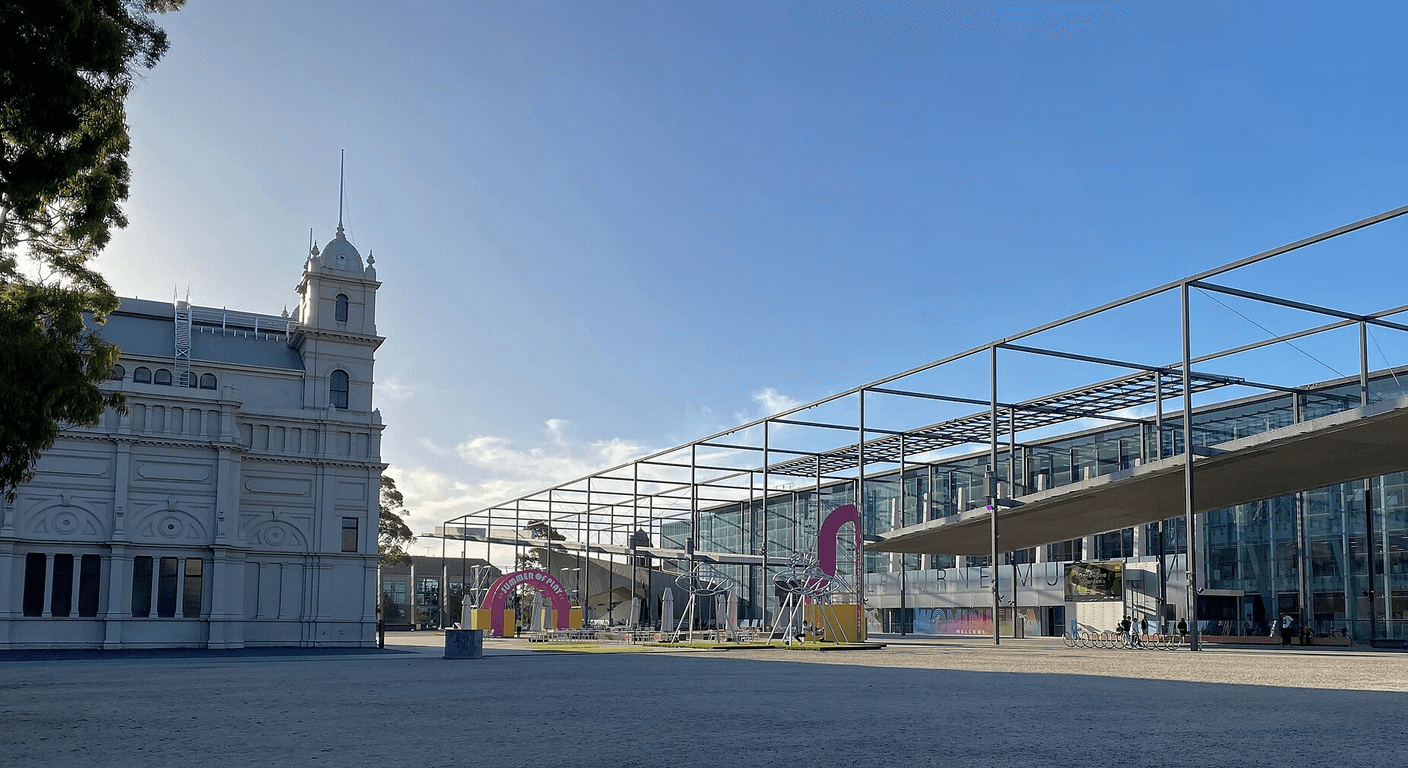
Melbourne Museum and the Carlton Gardens offer a full, unhurried day of culture, history and green space in the heart of the city. From the Bunjilaka Aboriginal Cultural Centre to Phar Lap's preserved heart, the museum rewards a slow, curious approach — and the World Heritage-listed Carlton Gardens just outside are ideal for a mid-day pause. This guide is written for older solo travellers who want substance over spectacle and a day that fits a sensible pace.
Why Melbourne Museum suits an older solo traveller
Melbourne Museum sits at the northern end of the Carlton Gardens on Nicholson Street, Carlton. It is one of the largest museums in the Southern Hemisphere, yet it is organised in a way that rewards a selective visit rather than demanding you see everything in one go. For a solo traveller in his late sixties, that distinction matters. You can spend two hours in Bunjilaka and the forest gallery, find a quiet bench near the café, and still have energy left for the gardens in the afternoon.
The museum draws a broad audience, but it is genuinely suited to older visitors — the permanent galleries are not cluttered, the signage is clear and well-lit, and the staff are generally approachable. There is no pressure to join a tour or follow a prescribed route. You set your own course, which is exactly what solo travel should feel like.
Concession entry is available for seniors holding a Victorian Seniors Card or a Commonwealth Seniors Health Card. The indicative concession price is around $15, though you should confirm the current rate on the Museums Victoria website or at the admissions desk before you visit, as prices are reviewed periodically. Full adult entry is higher, so it is worth having your card ready.
Getting there: tram and train options from central Melbourne
The most straightforward way to reach Melbourne Museum from the CBD is by tram. Route 86 (Bundoora or Watergardens via Latrobe Street) and Route 96 (East Brunswick via St Kilda) both stop on Nicholson Street close to the Carlton Gardens entrance. From Swanston Street or Bourke Street in the city, the journey takes roughly 15 minutes. Trams in Melbourne are free within the Free Tram Zone, which covers much of the CBD grid, but Carlton sits just outside that zone, so you will need a Myki card loaded with credit.
A Myki concession fare covers two hours of travel across the tram network for roughly $2 (indicative — check current fares at ptv.vic.gov.au before you travel). If you are coming from a suburban train station, Melbourne Central on the City Loop is a reasonable starting point: it is a short tram or a 20-minute flat walk up Swanston Street to the museum precinct. The walk along Swanston Street is largely footpath-friendly, though it is worth noting there are some uneven bluestone sections once you turn into Carlton.
Parking is available nearby on Rathdowne Street and surrounding streets, though it can be tight on weekdays. If you are driving, allow time to find a spot and consider the walk from the car to the museum entrance. The drop-off point on Carlton Street near the Exhibition Building is a useful option if someone is accompanying you by car.
Accessibility and getting around inside the museum
Melbourne Museum is genuinely accessible for visitors with mobility considerations. The main entrance on Carlton Street has step-free access, and lifts service all floors of the building. Wheelchairs and mobility scooters are available on loan from the cloakroom at no extra charge — it is worth calling ahead or checking the Museums Victoria website to confirm availability on the day you plan to visit. The floors inside are smooth and even throughout.
The galleries are spread across multiple levels, but none require stairs if you use the lifts. Signage to lifts is clear. Accessible toilets are available on each floor and are well maintained. The café on the ground floor has a mix of seating types, including chairs with arms, which many older visitors find more comfortable than low bench seating.
One honest note on pacing: Melbourne Museum is large, and trying to cover it all in a day will leave most people tired and underwhelmed by the end. A better approach is to choose two or three galleries as your focus and give them real time. The galleries covered in this guide — Bunjilaka, the science and life galleries featuring Phar Lap and the dinosaurs, and the Forest Gallery — represent a coherent half-day that leaves you with energy for the gardens.
Bunjilaka Aboriginal Cultural Centre: the heart of the museum
Bunjilaka occupies the ground floor of Melbourne Museum and is, for many visitors, the most affecting part of the building. It presents the history, culture and continuing presence of Aboriginal and Torres Strait Islander peoples of Victoria — not as a relic of the past but as a living, community-shaped story. The exhibitions include artefacts, oral histories, photography and contemporary art, and they are presented with care and depth that repays slow looking.
The Koorie Heritage section within Bunjilaka is particularly well considered. It covers the profound disruption of colonisation alongside the resilience and continuity of First Nations communities, and it does so without sentimentality or simplification. For a visitor who grew up in Victoria and has some familiarity with the history, there will be things here that reframe what you thought you knew. Allow at least 90 minutes if this is a genuine interest.
Photography is permitted in most areas of Bunjilaka, though some sacred or ceremonially sensitive items are marked as not to be photographed — it is worth reading the signage before reaching for your phone. The space is generally quieter than the upper floors, which makes it easier to read the interpretive text without distraction. Staff from the Koorie community are sometimes present in the gallery and are willing to speak with visitors.
Phar Lap, dinosaurs and the science galleries: what to see and what to skip
The upper floors of Melbourne Museum hold the natural science and history collections that most Victorians remember from school excursions. The dinosaur gallery, formally part of the Evolution gallery, features a well-mounted skeleton of an Allosaurus and several Australian fossil specimens that are genuinely impressive in person. The presentation is clear and not overly technical, which makes it accessible without feeling dumbed down.
Phar Lap's preserved heart is displayed in the science precinct and remains one of the most quietly moving objects in the building. The horse died in 1932 and his heart — unusually large, which may partly explain his extraordinary racing record — is held in a climate-controlled case. It is a small exhibit in physical terms, but it carries considerable weight for anyone who grew up in a household where Phar Lap was spoken of as something close to national mythology. His taxidermied body is held at Museum Victoria's Scienceworks in Spotswood, if that is of interest for a separate visit.
The Mind and Body gallery, which covers human biology and neuroscience, is worth a look if you have energy left after the main galleries. Some sections are interactive and designed for younger visitors, but the sections on ageing, sleep and memory are genuinely informative for an older audience. Skip the children's gallery (Melbourne Museum Gallery) unless you are with grandchildren — it is designed for under-tens and is usually noisy.
The Forest Gallery: a different kind of museum experience
The Forest Gallery is a living temperate forest enclosed within the museum building. It contains real trees, ferns, mosses, birds and lizards — a slice of Victorian bushland under a glass roof. Walking through it is a genuinely calming experience, especially after time spent in the denser, more information-heavy galleries. The path through the forest is flat and accessible, and there are benches at several points.
The gallery works best if you slow down and actually look. The interpretive signs are positioned low and at mid-height to accommodate different visitors, and they explain the ecological relationships between species rather than simply naming them. You may spot a lizard on a log or hear a bird call from somewhere in the canopy — the wildlife is real, not animatronic. It is one of those spaces that is easy to undervalue on a first visit and easy to linger in longer than expected.
The Forest Gallery connects through to the ground floor café area, which makes it a natural stopping point for a coffee or a light lunch before heading out to the Carlton Gardens. The café offers a reasonable range of hot food and cold options; prices are in line with other Melbourne museum cafés — indicatively around $6–$12 for a light lunch item, though you should confirm current pricing on the day.
Carlton Gardens and the Royal Exhibition Building: the afternoon outside
The Carlton Gardens are the formal Victorian-era gardens surrounding the Royal Exhibition Building, and together they constitute Victoria's only UNESCO World Heritage Site — listed in 2004. The gardens cover around 26 hectares and are largely flat, which makes them comfortable to walk through at a relaxed pace. The main paths are sealed or firm gravel, suitable for walking shoes or a mobility aid. There are public toilets near the museum entrance to the gardens and at the Exhibition Street end.
The Royal Exhibition Building itself is not open for self-guided entry — it functions as an events and examination venue — but guided tours run on selected days and are worth booking if you have a particular interest in the building's history. The building hosted the opening of the first Australian Parliament in 1901, and the guided tour covers both the architectural and political history in some depth. Tours run for around an hour; the concession price is indicative at around $10–$15, and current availability and pricing should be confirmed through the Museums Victoria website.
In the afternoon, the gardens offer a useful contrast to the museum's interior. The ornamental lakes, the formal plantings and the long views across to the Exhibition Building give the space a sense of scale and calm. On a mild Melbourne day, the gardens are genuinely pleasant for a solo hour of walking and sitting. Nearby Lygon Street in Carlton is a short walk west and offers a wide range of cafés and restaurants if you want to finish the day with a meal — it is one of Melbourne's established Italian dining strips and is well suited to solo diners, with many places offering counter seating or small tables.
Key takeaways
- Melbourne Museum offers concession entry for Victorian Seniors Card and Commonwealth Seniors Health Card holders — confirm the current rate before you visit.
- Tram routes 86 and 96 on Nicholson Street deliver you directly to the Carlton Gardens entrance; a Myki concession fare applies outside the Free Tram Zone.
- The museum is fully accessible with lifts to all floors, step-free entry and complimentary wheelchair loan from the cloakroom.
- Bunjilaka Aboriginal Cultural Centre is one of Australia's most considered First Nations cultural spaces and deserves at least 90 minutes of unhurried time.
- Phar Lap's heart is held at Melbourne Museum; his taxidermied body is at Scienceworks in Spotswood — two separate visits for the full story.
- The Carlton Gardens are largely flat, sealed-path accessible, and the Royal Exhibition Building guided tour is the only way to see the interior of Victoria's sole UNESCO World Heritage Site.
Where to look and book
Indicative prices only — always confirm with the operator before booking.
Frequently asked questions
How much does Melbourne Museum cost for seniors?
Concession entry to Melbourne Museum is available for holders of a Victorian Seniors Card or Commonwealth Seniors Health Card. The indicative price is around $15 concession, though pricing is reviewed periodically and you should confirm the current rate at museumsvictoria.com.au or at the admissions desk before your visit.
Is Melbourne Museum accessible for visitors with mobility issues?
Yes. Melbourne Museum has step-free entry, lifts to all floors, accessible toilets on each level, and complimentary wheelchair and mobility scooter loans available from the cloakroom. The gallery floors are smooth and even throughout. It is advisable to call ahead or check the Museums Victoria website to confirm mobility aid availability on your chosen day.
How do you get to Melbourne Museum by public transport?
Tram routes 86 and 96 both stop on Nicholson Street adjacent to the Carlton Gardens, close to the museum entrance. From the CBD, the journey takes around 15 minutes. Carlton sits outside the Free Tram Zone, so a Myki card loaded with concession credit is required. Check current fares and journey times at ptv.vic.gov.au.
Can you visit the inside of the Royal Exhibition Building?
The Royal Exhibition Building is not open for self-guided visits — it operates as an events and examination venue. Guided tours run on selected days and cover the building's architectural and political history, including its role as the site of Australia's first federal parliament in 1901. Confirm current tour dates, times and concession pricing at museumsvictoria.com.au.
How long does it take to see Melbourne Museum properly?
A focused visit covering Bunjilaka, the science galleries including Phar Lap, and the Forest Gallery takes roughly three to four hours at a comfortable pace for an older visitor. Attempting to see the entire museum in one day is tiring and not recommended. Choosing two or three galleries as your focus and allowing time for a café break gives a more satisfying and sustainable experience.
Got a tip, a price update or a story from this route? The community would love to hear it.
Share your views on our Facebook page— Seniors and Solo Traveller Stories
More melbourne
A Couple's Slow Day in Melbourne's Gardens and Markets: How to Spend Almost Nothing
A gentle, low-cost day out in inner Melbourne built around free gardens, cheap market eating and easy public transport…
A Day Out With the Girls in Melbourne's CBD: Free Galleries, Cheap Eats and Easy Trams
A practical plan for a group of friends over 60 to enjoy Melbourne's inner city on a budget: free galleries, the NGV,…
A Solo Winter Day in Melbourne's CBD: Free Galleries, Warm Corners and Quiet Pleasures
A practical, gentle plan for spending a winter day alone in Melbourne's inner city without spending much. It covers fr…