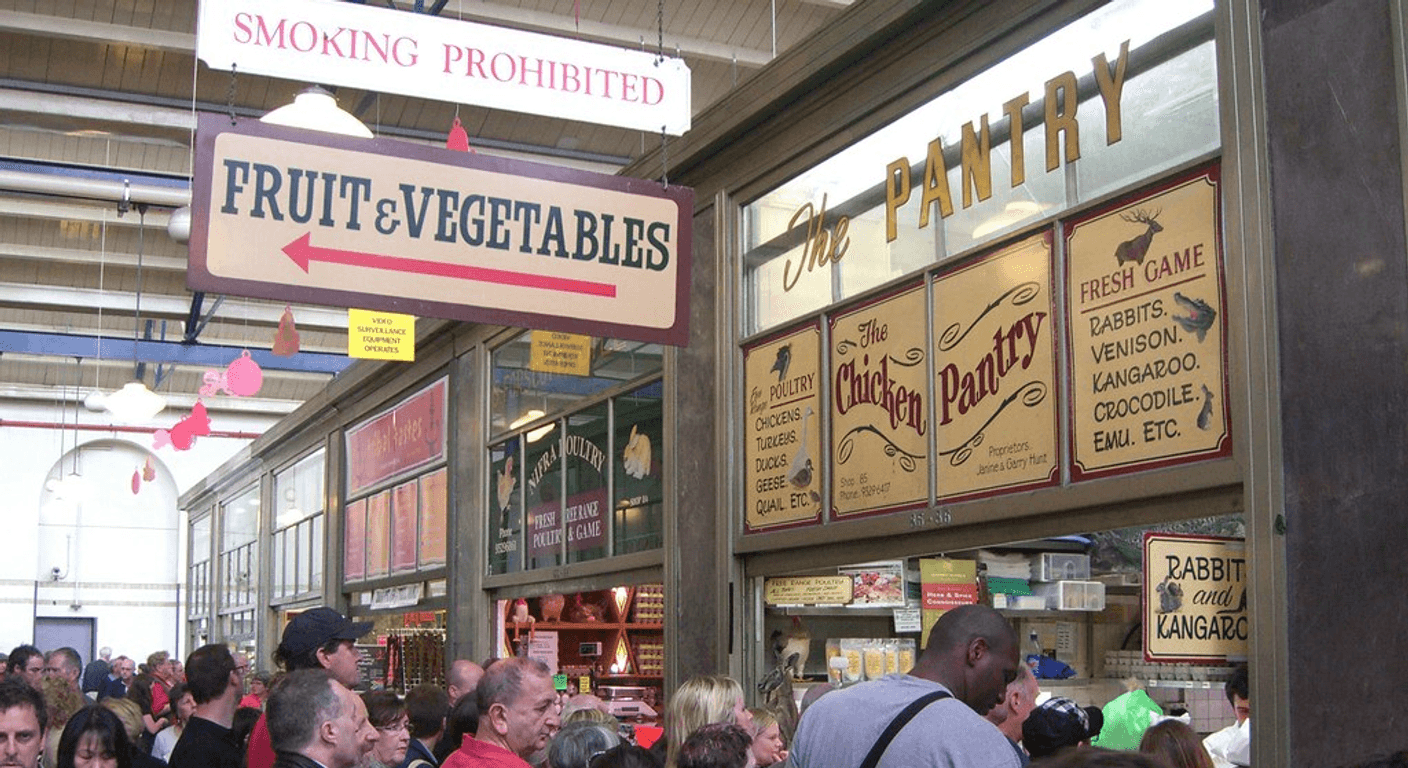
Queen Victoria Market is one of Melbourne's great pleasures for a couple who know how to take their time — and at 73, with a lifetime of good food behind you, you know exactly what you're looking for. This guide covers a food-lover's morning at the market: the deli hall, the produce sheds, the bratwurst sizzle, the börek, the flat white, and the string-bag full of things to cook at home. It also covers the practical side: when to go, how to get there without a car, where to sit down, and what it will roughly cost.
Why Queen Victoria Market Works So Well for a Couples' Morning
There is a particular kind of satisfaction in walking through a real food market with someone you know well — pointing out the good oil, arguing gently about whether you need another wedge of cheese, stopping for coffee without anyone rushing you along. Queen Victoria Market, which has been trading on the corner of Victoria and Elizabeth Streets since 1878, is built for exactly that kind of morning. It is large enough to be interesting and varied enough to hold your attention for two or three hours without ever feeling like hard work.
For a couple with Mediterranean food instincts — someone who grew up around good olives, proper cheese, and the smell of fresh bread — the deli hall alone could take an hour. Add the produce sheds, a bratwurst at the hot food strip, a börek from one of the Turkish pastry vendors, and a flat white at one of the market's established coffee spots, and you have a complete morning. You also go home with something: the string bag gets filled, the fridge gets restocked, and dinner more or less plans itself.
The market is also genuinely accessible and unhurried by Melbourne standards. There is no queue to enter, no ticket to buy, and no obligation to spend anything at all. You can move at your own pace, find a seat when you need one, and leave whenever you are ready. That matters more than people tend to admit when they are planning a day out.
Which Days Is Queen Victoria Market Open — and When Should You Go?
Queen Victoria Market does not trade every day, and getting the days wrong is the most common mistake visitors make. As of 2026, the general trading days are Tuesday, Thursday, Friday, Saturday, and Sunday. The market is closed on Mondays and Wednesdays, and it is also closed on Good Friday and Christmas Day. Hours vary by section and by day — the fresh produce and deli sheds typically open from around 6am on Tuesday and Thursday, and from around 6am on weekends, closing in the early afternoon. Always confirm current hours on the official QVM website before you go, as trading hours can shift with the renewal works.
For a food morning, Tuesday or Thursday suits couples who want a quieter experience. The weekend market is lively and social, but Saturday in particular draws large crowds from mid-morning onward, which can make the deli hall and hot food strip harder to navigate slowly. If you enjoy the energy of a busy market, Saturday is fine — just aim to arrive before 9am to move comfortably through the sheds. Sunday is generally a little calmer than Saturday and still has full produce and deli trading.
The sweet spot for a relaxed couple's morning is a weekday — Tuesday or Thursday — arriving around 7am to 8am. The light is good, the stall holders are in good spirits, the produce is freshest, and you can have your bratwurst and coffee without jostling for a bench. By 10am on a Saturday, the main aisles are noticeably busier, which is worth knowing if one of you uses a walking stick or prefers space to move.
Getting There: The Free Tram and Other Options
Queen Victoria Market sits squarely inside Melbourne's Free Tram Zone, which covers the CBD and inner city. If you are coming from the city centre or a nearby hotel, you can board a tram on Elizabeth Street, Swanston Street, or La Trobe Street and ride to the market stop without touching your Myki card. Route 58 (running along William Street) stops directly at the market on Elizabeth Street. Routes 19, 57, and 59 also pass close by on Elizabeth Street. The PTV website has a journey planner that will give you the exact stop and route from wherever you are staying.
If you are coming from further out — say, from a suburb on the Craigieburn, Upfield, or Flemington lines — you can take a train to Melbourne Central station, which is about a ten-minute walk from the market, or to Flagstaff station, which is a little closer. Both walks are relatively flat. Driving is possible but not recommended: the Elizabeth Street precinct is busy, and market-day parking nearby can be expensive and limited. The free tram option is genuinely the easier choice for most visitors.
For couples where one partner has reduced mobility, the tram is low-floor on most modern routes, and the market's main entrances on Elizabeth Street and Queen Street have no significant steps. The interior of the sheds is on level ground, though the surface is uneven in places — worn bluestone and concrete — so supportive footwear matters. A walking stick is no obstacle here, but a full-size wheelchair or scooter would find the deli hall tight during peak hours. The market's official accessibility information is worth reading on the QVM website if this is a consideration.
The Deli Hall: Where to Slow Down and Take Your Time
The Deli Hall — the long, covered building running along the Elizabeth Street side of the market — is the heart of the food morning. It is where you find the European-style grocers, the cheese vendors, the smallgoods, the pickled and preserved things, the imported pantry staples, and the kind of olives that remind you of a particular place or a particular person. For anyone who grew up in a household where the pantry was taken seriously, this hall has a familiar, comfortable quality that is hard to find in a supermarket.
Several vendors here specialise in Greek, Italian, and broader Mediterranean produce — taramosalata, dolmades, feta in brine, loukoumades mix, dried herbs, good olive oil. You do not need a list; you will recognise what you want when you see it. Prices are generally competitive with good delicatessens, and the quality is noticeably higher than supermarket equivalents. Indicative spending in the deli hall for a couple picking up a few things — some cheese, olives, a smallgoods selection — might run to around $40 to $70, but this is entirely dependent on what you choose. Confirm any pricing directly with vendors on the day.
Take your time talking to the stall holders. Many of them have been trading here for years, some for decades, and they know their product. If you are after a specific style of feta, or want to know which salami is made locally versus imported, it is worth asking. That kind of conversation is part of what makes a deli hall different from a shop, and the morning is long enough to enjoy it.
The Produce Sheds, the Bratwurst, and the Börek
The open-air and covered produce sheds run through the centre of the market and carry fruit, vegetables, herbs, nuts, and dried goods from Victorian growers and wholesalers. The quality is seasonal and honest — you are buying what is actually in season, which for a cook is the point. In autumn and winter, look for good pumpkins, leafy greens, and root vegetables. In summer, the stone fruit and tomatoes are worth buying in quantity. Prices are generally lower than supermarkets for equivalent quality, and buying a full bag of produce for the week — tomatoes, capsicums, eggplant, potatoes, whatever is looking good — might cost a couple around $25 to $40 as a rough guide. Always check current prices on the day.
The hot food strip on the Therry Street side of the market is where the bratwurst comes from, and it has been coming from roughly the same spot for a long time. The Bratwurst Shop is a QVM institution — a long German pork sausage in a bread roll, with mustard and sauerkraut if you want it, eaten standing up or on a bench nearby. It is not a refined eating experience. It is simply a very good sausage, and it costs roughly $10 to $12 as an indicative figure — confirm current pricing at the stall. It is the kind of thing you eat once and then find yourself thinking about on the tram home.
The börek — the Turkish pastry stuffed with spinach and cheese, or minced meat — comes from one of several Turkish pastry vendors in the market, most notably in the deli hall and the upper market area. For someone with a Greek or broader Mediterranean background, börek needs no introduction; it is close enough to spanakopita to feel familiar, and the versions at QVM are made fresh. A piece costs roughly $5 to $8 as an indicative figure; again, confirm on the day. Between the bratwurst and the börek, most couples find they have eaten enough to call it a proper morning.
Coffee, Seating, and Pacing the Morning
Coffee at the market is taken seriously. There are several established coffee vendors trading inside and around the sheds, and the quality is consistent with what you would expect from a Melbourne market that has been feeding locals for generations. The busiest spots can have a short queue from around 8.30am onward on weekends, but waiting five minutes for a good flat white is not a hardship. If you prefer a sit-down café experience rather than a takeaway cup, the streets immediately surrounding the market — particularly Queen Street and Therry Street — have several cafés within easy walking distance.
Seating inside the market is available but not abundant. There are bench seats near the hot food strip and some shared tables in the covered areas. On a busy Saturday morning these fill up, so if sitting down to eat is important — and at 73, it often is — a weekday visit or an early Saturday arrival makes a meaningful difference. The benches near the bratwurst strip are the most practical for eating; they are close to the food and sheltered from weather.
A sensible pacing plan for a couple doing a full food morning: arrive early (7am to 8am on a weekday, before 9am on a weekend), walk the produce sheds first while legs are fresh, then take the deli hall slowly, then finish with hot food and coffee before the crowd builds. Allow two to two-and-a-half hours without feeling rushed. If one partner tires more quickly, the seating near the hot food strip makes a natural halfway point to rest while the other browses further. The market is not a place that rewards rushing, and there is no reason to rush.
What to Bring Home: The String-Bag Haul
The string bag — or a good canvas tote — is worth bringing from home or picking up at the market itself (several stalls sell them). A well-planned shop at QVM for two people might include: a block of good feta or a wedge of aged parmesan from the deli hall, a length of local salami or some prosciutto, a jar of olives, a bag of seasonal vegetables, some fresh herbs, a packet of dried pasta or a bag of nuts, and perhaps a small jar of preserved something — capsicum, eggplant, artichoke — to open later in the week. That kind of haul can be assembled for a rough indicative total of $60 to $100 for two people, depending entirely on what you choose. Treat any cost figure here as a starting point only and confirm current prices with vendors on the day.
The practical advantage of buying at QVM rather than a supermarket is not just price — it is that you come home with things that have a story. You know the stall holder told you the feta is from a particular producer, or that the tomatoes came in that morning. For someone who cooks with attention and takes the pantry seriously, that detail matters. It also makes the afternoon at home more enjoyable: putting away a good market haul is its own small pleasure.
One practical note: the market does not provide bags, so bring your own. A wheeled shopping trolley is genuinely useful here if you plan to buy produce in any volume — it saves carrying weight and is easy to manoeuvre through the sheds on a weekday. On a busy Saturday, a trolley requires a little more patience in the narrow deli hall aisles, but it is still manageable.
Key takeaways
- Queen Victoria Market trades Tuesday, Thursday, Friday, Saturday, and Sunday — it is closed Mondays, Wednesdays, Good Friday, and Christmas Day.
- The free tram zone covers the market precinct; Route 58 on Elizabeth Street stops directly at the market at no cost.
- Tuesday and Thursday mornings before 9am offer the most relaxed experience for couples who prefer space and pace.
- The deli hall is where the serious food shopping happens — olives, feta, smallgoods, and Mediterranean pantry staples from long-standing vendors.
- A bratwurst from the Bratwurst Shop and a börek from the Turkish pastry vendors are the two essential hot food stops of any QVM morning.
- Bring a string bag or wheeled trolley — the market does not provide bags, and a full produce haul for two is worth carrying comfortably.
Where to look and book
Indicative prices only — always confirm with the operator before booking.
Frequently asked questions
What days is Queen Victoria Market open in 2026?
As of 2026, Queen Victoria Market trades on Tuesday, Thursday, Friday, Saturday, and Sunday. It is closed on Mondays and Wednesdays, and also on Good Friday and Christmas Day. Hours vary by section and can change during the market's renewal works, so check the current schedule at qvm.com.au before you visit.
Is Queen Victoria Market accessible for older visitors or those with mobility needs?
The main entrances on Elizabeth Street and Queen Street are step-free, and the interior sheds are on level ground, though the surface is uneven in places — worn bluestone and concrete — so supportive footwear is recommended. A walking stick is no obstacle, but a full wheelchair or mobility scooter may find the deli hall tight during peak hours. The QVM website carries current accessibility information.
How do you get to Queen Victoria Market on public transport from the Melbourne CBD?
The market is inside Melbourne's Free Tram Zone, so tram travel from the city centre is at no cost. Route 58 on Elizabeth Street stops directly at the market. Flagstaff and Melbourne Central train stations are also within walking distance — roughly five to ten minutes on flat ground. The PTV journey planner at ptv.vic.gov.au can give you the exact route from your starting point.
What is the best time to arrive at Queen Victoria Market for a relaxed morning?
For a relaxed couples' morning, arriving between 7am and 8am on a Tuesday or Thursday is ideal — the produce is freshest, the aisles are quieter, and you can move at your own pace. On Saturday, aim to arrive before 9am to avoid the busiest period, which typically builds from mid-morning onward.
How much should you budget for a food morning at Queen Victoria Market?
As a rough and indicative guide, a couple doing a full deli hall and produce shop — plus a bratwurst and a börek each, and two coffees — might spend somewhere between $80 and $130 in total, depending on what they buy. These are indicative figures only; confirm all current prices with individual vendors and stalls on the day.
Got a tip, a price update or a story from this route? The community would love to hear it.
Share your views on our Facebook page— Seniors and Solo Traveller Stories
More melbourne
A Couple's Slow Day in Melbourne's Gardens and Markets: How to Spend Almost Nothing
A gentle, low-cost day out in inner Melbourne built around free gardens, cheap market eating and easy public transport…
A Day Out With the Girls in Melbourne's CBD: Free Galleries, Cheap Eats and Easy Trams
A practical plan for a group of friends over 60 to enjoy Melbourne's inner city on a budget: free galleries, the NGV,…

A Solo Winter Day in Melbourne's CBD: Free Galleries, Warm Corners and Quiet Pleasures
A practical, gentle plan for spending a winter day alone in Melbourne's inner city without spending much. It covers fr…