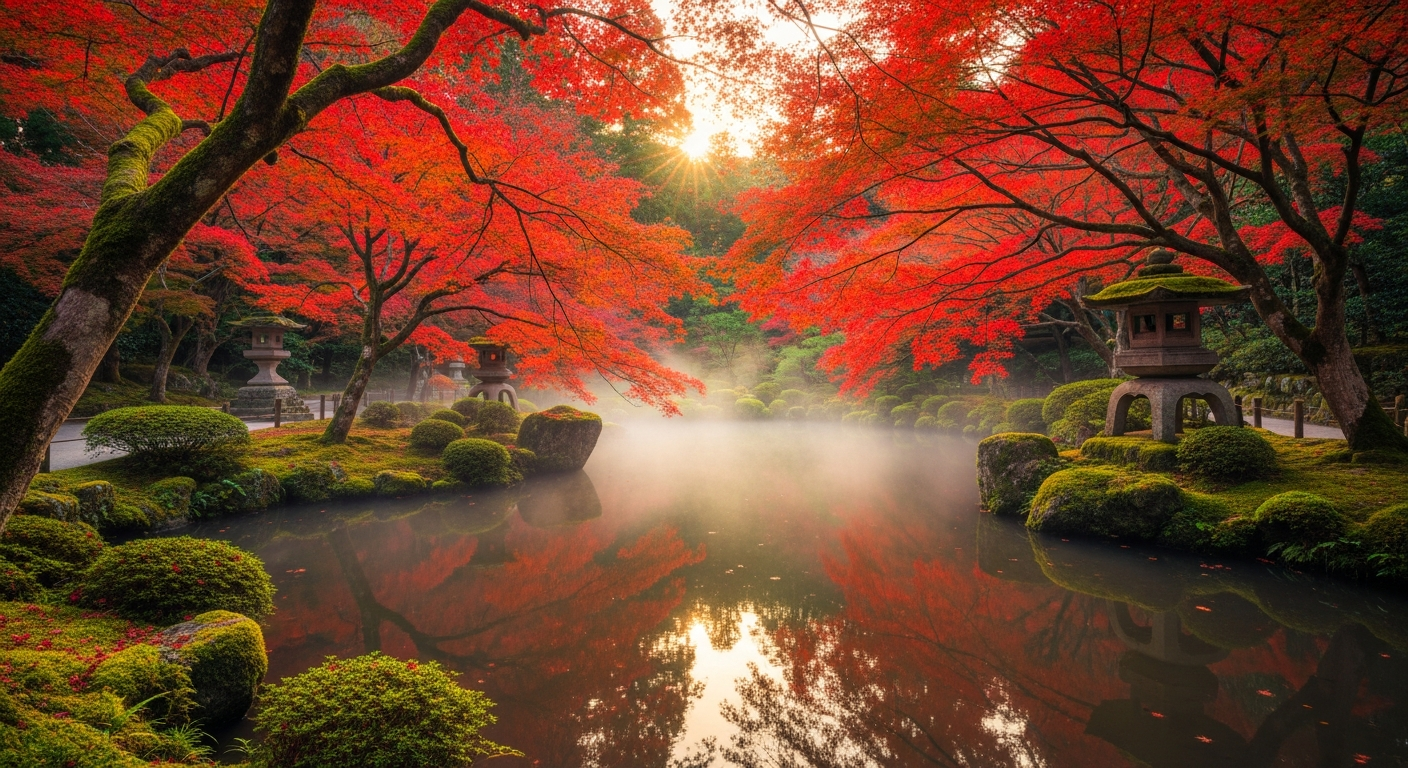
Spring gets the headlines, but autumn in Japan is gentler on the body and the wallet for older travellers. This guide covers when to go, how to pace it, accessibility, and realistic AUD costs for a couple from Victoria.
Why choose autumn over the famous spring blossoms?
Everyone talks about the cherry blossoms, but Japan in autumn arguably suits older travellers better. The weather from late October into early December is cool and dry, usually sitting between 10 and 18 degrees in the day. That is far kinder than the humidity of summer, and it means long walking days through gardens and temples without arriving back at the hotel exhausted.
The autumn colour, what the Japanese call koyo, moves from north to south over several weeks. This is actually helpful. Instead of chasing one short blossom window, you have a longer, more forgiving season, which takes the pressure off booking and lets you travel at a calmer pace.
When does the autumn colour actually peak?
As a rough guide, the colour reaches Hokkaido and the higher mountains in mid to late October, Tokyo and the Kyoto area from mid-November to early December, and the far south a little later. For a couple based in Victoria, a trip starting in the third week of November gives you a good chance of catching peak colour in Kyoto and Nara, which is where most people want to be.
Foliage timing shifts a little each year with the weather, so avoid booking non-refundable accommodation to a single exact date. The Japan National Tourism Organization publishes seasonal forecasts each year — worth checking a few weeks out before locking in day trips.
How should an over-60 couple pace the trip?
A useful rule is three nights minimum in each base, so you are not packing and dragging cases every second morning. A comfortable two-week trip might be three nights in Tokyo, four in Kyoto as a base for Nara and Arashiyama, three in Kanazawa or Takayama, and a couple of nights back in Tokyo before flying home.
Build in rest days. Japan tempts you to do too much because the trains run so well. Keep one day in three free of any fixed plan, often spent in a garden or a department store food hall, which are an experience in themselves and a good place to sit down.
Is Japan accessible for travellers who tire easily?
Japan is one of the easier countries for mobility. Major stations have lifts and escalators, the shinkansen has wheelchair spaces you can reserve, and station staff will help with luggage and ramps if you ask. Taxis are clean, metered and plentiful, and the drivers are courteous even when you have no Japanese.
The honest caveat is stairs. Older shrines, temples and some smaller train stations still involve steps, and footpaths in historic districts can be uneven. If one of you uses a stick or tires on long inclines, research individual sites in advance rather than assuming every famous spot has a gentle path. A folding walking stick and good shoes earn their place in the case.
Is the rail pass still worth it in 2026?
The nationwide Japan Rail Pass rose sharply in price in late 2023, so it is no longer the automatic bargain it once was. As a rough figure, a 7-day ordinary pass sits around A$560 per person in 2026. It pays off only if you do serious long-distance travel, such as Tokyo to Kyoto and on to a third region and back.
For a slower itinerary built around a Kyoto base, you may be better off with a regional pass or simply buying individual tickets and topping up an IC card such as Suica or ICOCA for local trains. Do the sums on your actual route before buying. A single Tokyo to Kyoto shinkansen leg is roughly A$140 one way, so two or three long hops is the tipping point.
What will it cost from Victoria, in AUD?
Return economy flights from Melbourne to Tokyo in November typically run from about A$1,200 to A$1,800 per person depending on how early you book and whether the flight is direct. Booking around five to six months ahead gets the best fares in shoulder season.
On the ground, a comfortable mid-range hotel for two costs roughly A$180 to A$280 a night in the cities. Meals are good value: a satisfying lunch set is often A$12 to A$20 each, and a relaxed dinner A$35 to A$60 each. As a working figure, a couple can travel well on around A$350 to A$450 a day for two, excluding flights and the rail pass. There is no concession scheme for foreign visitors, but the strong value of everyday eating and transport more than makes up for it.
A few practical notes worth knowing
Cash still matters more than you would expect. Many smaller restaurants and shrines are cash only, so carry yen and withdraw it from 7-Eleven or post office ATMs, which reliably accept Australian cards. Travel insurance with proper medical cover is non-negotiable at this age, and it is worth checking Smartraveller before you go.
Forwarding your luggage between hotels through the takkyubin courier service is a small luxury worth every yen. For around A$15 to A$25 a case, your bags travel ahead and you ride the train with just a day pack. For two people who no longer enjoy heaving suitcases up stairs, it changes the whole trip.
Key takeaways
- Autumn (mid-November to early December in the main cities) is cooler, drier and less frantic than the spring blossom season.
- Stay at least three nights per base and keep one rest day in three.
- The nationwide JR Pass is around A$560 for 7 days and only pays off on long-distance routes; check your route first.
- Budget roughly A$350-A$450 a day for a couple on the ground, plus flights from about A$1,200 each return.
- Japan is largely accessible, but historic sites still involve stairs and uneven paths.
- Use luggage forwarding (takkyubin) and carry cash from 7-Eleven ATMs.
Where to look and book
Indicative prices only — always confirm with the operator before booking.
Frequently asked questions
Is autumn or spring better for older travellers in Japan?
Both are lovely, but autumn is often kinder for over-60 travellers because the weather is cool and dry and the colour season lasts several weeks, reducing booking pressure compared with the short spring blossom window.
Do I need the Japan Rail Pass?
Only if you cover long distances. As of 2026 a 7-day pass is around A$560 per person, so it pays off with two or three long shinkansen legs. For a slower trip, individual tickets and an IC card are often cheaper.
Are there seniors discounts for foreign visitors?
No, Japan does not offer a tourist seniors concession scheme. The good value comes from inexpensive everyday meals and reliable public transport rather than age-based discounts.
How much should a couple budget per day?
Around A$350 to A$450 a day for two on the ground, covering mid-range accommodation, meals and local transport, excluding flights and any rail pass.
Is it easy to manage with limited mobility?
Stations, trains and taxis are very accessible and staff are helpful, but many temples and historic districts still have stairs and uneven paths, so research individual sites in advance.
Got a tip, a price update or a story from this route? The community would love to hear it.
Share your views on our Facebook page— Seniors and Solo Traveller Stories
More holidays
A Couple's Halong Bay and Hanoi Fortnight: Cruising Northern Vietnam at a Steady Pace, With Honest AUD Costs
Northern Vietnam suits over-60 couples who want a slower trip with comfort and good food. This 14-day plan pairs Hanoi…
A Tasmanian Food and Wine Trip for Two Over 60: Slow Days, Cellar Doors and the Spirit of Hobart
A gentle seven to ten day food and wine trip through Tasmania suits over-60 couples who want short drives, good meals…
Adelaide and the Barossa for Two Over 60: A Gentle Week With Real AUD Costs
Adelaide is one of Australia's most relaxed capitals for older travellers, and it pairs beautifully with a few unhurri…