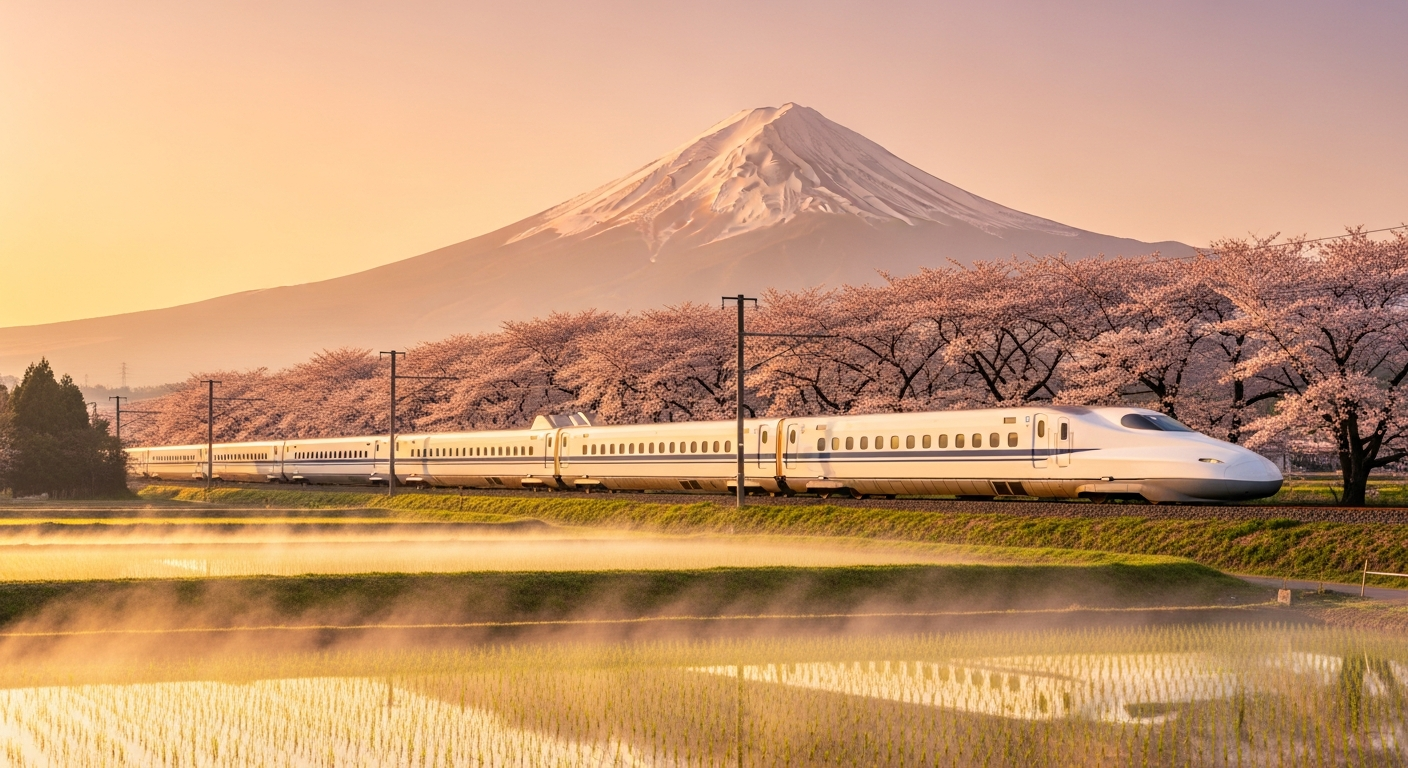
A practical guide for Victorian couples over 60 planning a relaxed train trip through Japan. Covering whether the Japan Rail Pass still makes sense after the 2023 price rise, comfortable pacing, accessibility and realistic AUD costs.
Why consider Japan by train at this age?
Japan is a country to travel by train, leaving the hire car idea at home. The trains do the heavy lifting, and that suits two people in their seventies who would rather watch the country roll by than wrestle with unfamiliar roads and signs.
Japan rewards a slower pace. The stations are clean, the staff are patient, and the timetables run to the minute. For a couple who value comfort and predictability, that reliability is worth more than any single sight.
Is the Japan Rail Pass still worth buying?
Here is the honest part. In October 2023 the nationwide Japan Rail Pass went up by roughly two-thirds, and it has stayed at that higher level into 2026. A 7-day ordinary pass now sits around A$560 per person, and the 14-day around A$890. That changed the maths considerably.
The pass pays off if you cover long distances quickly. A return Tokyo to Kyoto trip alone gets you most of the way there. But if you plan to settle in one or two cities and take day trips, you may do better buying individual tickets or a regional pass. Sit down with your rough route before you commit.
What does a couple actually spend?
For two people over a fortnight, a realistic mid-range budget is about A$650 to A$900 per day combined, covering a comfortable hotel, breakfasts, two meals out, local transport and entry fees. That is not budget-backpacker territory, nor is it luxury.
Twin rooms are the norm in Japan, so couples avoid the single supplement that solo travellers face. A solid business hotel twin runs A$160 to A$260 a night. Meals are good value: a filling lunch set is often A$12 to A$20 per person, and a sit-down dinner A$30 to A$55.
How accessible are the trains and stations?
Japan handles older travellers well. Major stations have lifts and escalators, and platform staff will help with luggage if you ask. On the shinkansen you can reserve a seat near the door, and there are designated spaces for wheelchairs and mobility aids if booked ahead.
The catch is the luggage. From May 2023, oversized bags on the shinkansen must be booked into a special space in advance, and stairs still appear at smaller stations. Sending larger cases ahead using takkyubin, the door-to-door luggage service, for around A$25 to A$35 a bag removes the stress entirely.
When is the best season to go?
Spring, late March to mid-April, brings the cherry blossom, but crowds and prices peak. Autumn, late October to November, offers cool, settled weather and the maple colours, and is the pick for comfort. Both seasons are kind on older knees, with mild temperatures for walking.
Avoid the deep heat and humidity of July and August if you can. Summer is draining, and the indoor reprieve of air conditioning only goes so far. Winter is quieter and cheaper, though snow makes some footpaths slick.
How should you pace the trip?
Resist the urge to tick off ten cities. A relaxed three-base plan works well: several nights in Tokyo, several in Kyoto, and a quieter spot such as Kanazawa or Hiroshima. Day trips fan out from each base without constant packing and unpacking.
Build in rest days. One slow day for every two active ones, and never more than two attractions before lunch, works well. At this age, the trip you remember fondly is the one that did not exhaust you.
What about flights and getting there from Victoria?
Direct flights from Melbourne to Tokyo run with several carriers, and return economy fares typically land between A$1,100 and A$1,900 depending on season, with the cherry blossom and autumn windows at the top end. Book three to five months ahead for the best of it.
Consider premium economy if the long leg troubles your back. It adds roughly A$800 to A$1,400 return per person, which is real money, but it changes how you feel on arrival.
Key takeaways
- The Japan Rail Pass rose sharply in 2023 and only pays off for long, fast cross-country routes; check your route first.
- A 7-day ordinary pass is around A$560 per person in 2026; the 14-day around A$890.
- Couples avoid the single supplement, as twin rooms are standard at A$160 to A$260 a night.
- Send large luggage ahead with takkyubin for about A$25 to A$35 a bag to avoid station stairs.
- Oversized bags on the shinkansen must be reserved in advance since 2023.
- Autumn (late October to November) offers the most comfortable weather for older walkers.
Where to look and book
Indicative prices only — always confirm with the operator before booking.
Frequently asked questions
Do we need to buy the rail pass before leaving Australia?
No. Since 2017 you can buy the nationwide pass inside Japan, though it costs a little more there. Buying online before departure is still simplest for most travellers.
Is there a seniors discount on Japanese trains?
There is no broad foreign-senior discount on standard fares. JR offers a domestic over-50 club, but it is aimed at residents. Your savings come from choosing the right pass and reserving wisely.
Can we manage with limited mobility?
Yes, with planning. Major stations have lifts, staff assist on platforms, and shinkansen wheelchair spaces can be booked ahead. Smaller rural stations are less reliable for step-free access.
How much cash should we carry?
Cards are widely accepted in cities, but rural areas and small eateries often want cash. Carry a few hundred dollars worth of yen and top up at convenience-store ATMs as needed.
Is travel insurance essential?
Yes. Japanese medical care is excellent but costly for visitors. Buy comprehensive insurance that covers your age and any pre-existing conditions before you go.
Got a tip, a price update or a story from this route? The community would love to hear it.
Share your views on our Facebook page— Seniors and Solo Traveller Stories
More holidays
A Couple's Halong Bay and Hanoi Fortnight: Cruising Northern Vietnam at a Steady Pace, With Honest AUD Costs
Northern Vietnam suits over-60 couples who want a slower trip with comfort and good food. This 14-day plan pairs Hanoi…
A Tasmanian Food and Wine Trip for Two Over 60: Slow Days, Cellar Doors and the Spirit of Hobart
A gentle seven to ten day food and wine trip through Tasmania suits over-60 couples who want short drives, good meals…

Adelaide and the Barossa for Two Over 60: A Gentle Week With Real AUD Costs
Adelaide is one of Australia's most relaxed capitals for older travellers, and it pairs beautifully with a few unhurri…