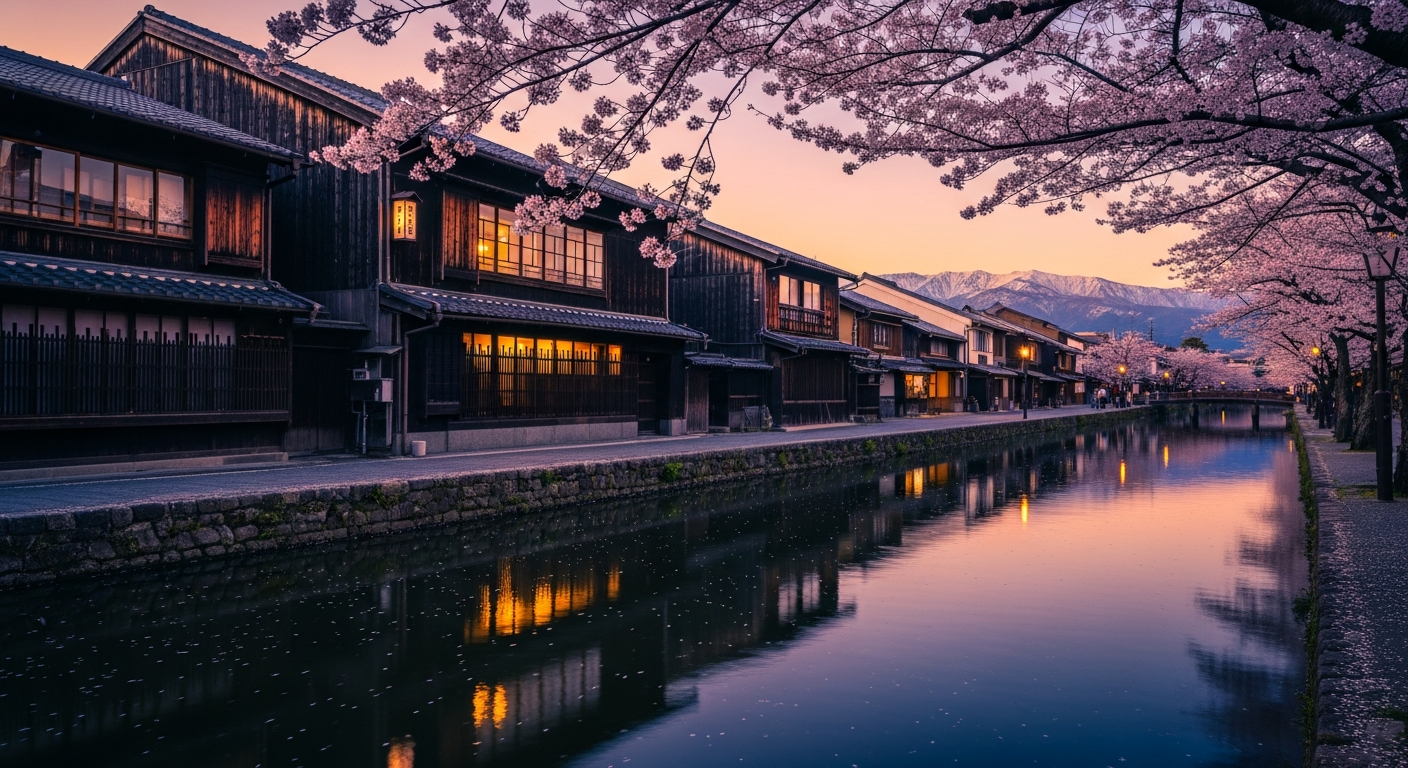
A 14-day solo spring trip through Japan that skips the worst of the Kyoto crowds in favour of Kanazawa, Takayama and Matsumoto. Includes honest AUD costs, rail pass advice and practical accessibility notes for over-60 travellers from Victoria.
Why go to Japan's quieter towns in spring rather than chase Kyoto?
Picture a Kyoto laneway in early April, shoulder to shoulder with several hundred other people, all pointing their phones at the same branch. It is lovely, but it is not restful — and past a certain age, restful matters as much as beautiful.
So this trip takes a different shape. You still see the blossom, but in Kanazawa, Takayama and Matsumoto, where the trees line gentler streets and you can find a bench to yourself. Spring in Japan runs roughly late March through April, with the blossom moving north as the weeks go on, so timing the smaller towns gives you a fighting chance of catching it without the crush.
What does a 14-day route look like at a gentle pace?
A workable shape: fly into Tokyo, three nights settling in, then west — two nights Kanazawa, two nights Takayama, two nights Matsumoto, then back toward Tokyo with a couple of nights spare for the bits you missed. That is six moves in two weeks, about the limit before the packing and unpacking starts to grind.
The trains do the heavy lifting. Tokyo to Kanazawa on the Hokuriku Shinkansen takes around two and a half to three hours. Kanazawa to Takayama is a slower, prettier run by limited express and bus. Takayama to Matsumoto involves a change but rewards you with mountains the whole way. None of these are punishing, and every leg has reserved seats so you are never left standing.
Is the Japan Rail Pass still worth it for this trip?
Be honest with yourself before you buy. The 7-day ordinary nationwide pass jumped in price in late 2023 and now sits at roughly A$540, so it only pays off if you are covering a lot of long-distance ground in a short window.
For a slower fortnight like this, individual tickets and a regional pass often work out better. The JR East-West and Hokuriku Arch passes can cover the Tokyo-Kanazawa corridor at better value. As a rule of thumb, if you are doing one big Shinkansen return plus local trains, single tickets often win. Do the sums on the official site before you commit, and remember you can buy most tickets once you arrive rather than in advance.
How accessible is Japan for older travellers?
Better than people expect, and better than Australia in some ways. Shinkansen platforms are level or have lifts, station staff will help you with bags and connections, and you can request assistance at the ticket gate. Major stations have lifts and escalators, though some smaller ones still have stairs only.
The real effort is the walking. Japan is a walking country and the temples and old quarters involve cobbles, slopes and the occasional steep step. One good pair of broken-in shoes, a light folding stick for bad-knee days, and the takkyubin luggage service to send your main suitcase ahead between hotels — around A$20 to A$30 per bag — means travelling with just a daypack on train days. That single habit changes Japan.
What does it actually cost in AUD?
Return flights Melbourne to Tokyo in shoulder spring run roughly A$1,300 to A$1,900 if you book a few months ahead. Mid-range business hotels and ryokan with private facilities cost around A$120 to A$220 a night, and as a solo traveller you usually pay close to the same as a couple, so factor in a quiet single-room premium.
On the ground, budget around A$90 to A$130 a day for food, local transport and entry fees, less if you lean on convenience-store breakfasts and noodle lunches, which are genuinely good. All up, two weeks excluding flights comes to roughly A$3,500 to A$4,500 travelling comfortably but not lavishly. A travel-friendly card with low foreign fees saves more than you would think over a fortnight.
How do you manage the language and the small worries solo?
No Japanese beyond please and thank you is needed to manage fine. Translation apps cover menus and signs, ticket machines have an English button, and people are unfailingly kind about pointing you the right way. Carry your hotel's name and address written in Japanese on a card for taxis.
For peace of mind, a data eSIM bought before leaving keeps maps and messages working, and registering the trip with Smartraveller is wise. Japan is one of the easier places to be a woman travelling alone — walking back to the hotel after dinner feels safe, which is not something to take for granted.
Key takeaways
- Spring blossom can be enjoyed without the Kyoto crowds by basing in Kanazawa, Takayama and Matsumoto.
- The 7-day Rail Pass now costs about A$540 and only pays off for high-mileage trips; price single tickets and regional passes for slower routes.
- Send your main bag ahead by takkyubin for around A$20-A$30 to travel light on train days.
- Budget roughly A$3,500-A$4,500 for two weeks excluding flights, travelling comfortably.
- Solo travellers pay close to couple rates for rooms, so build in a single-room premium.
- Japan's stations are well staffed and accessible; the main physical demand is walking on cobbles and slopes.
Where to look and book
Indicative prices only — always confirm with the operator before booking.
Frequently asked questions
When exactly is cherry blossom season in 2026?
Blossom timing varies year to year and moves south to north. Tokyo and the lowlands typically peak late March to early April, while cooler mountain towns like Takayama and Matsumoto often peak a week or two later. Check forecasts close to your travel dates rather than booking around fixed dates.
Do I need to buy the Rail Pass before I leave Australia?
No. You can now buy most Japan Rail Passes and individual tickets after you arrive. For a slower trip, individual or regional tickets often work out cheaper than the nationwide pass, so do the sums first.
Is Japan suitable if I have limited mobility?
Shinkansen and major stations are well equipped with lifts and staff assistance you can request at the gate. The challenge is walking on cobbles, slopes and steps in old quarters and temples. A folding stick, good shoes and sending luggage ahead make a big difference.
Is it safe to travel solo as an older woman in Japan?
Japan is widely regarded as one of the safer destinations for solo women, with low crime and helpful locals. Standard precautions apply, and registering with Smartraveller and carrying your hotel address in Japanese are sensible steps.
How much should I budget for food each day?
Around A$90 to A$130 a day covers meals, local transport and entry fees comfortably. Convenience-store breakfasts and noodle lunches are good quality and keep costs down, leaving room for a nicer dinner.
Got a tip, a price update or a story from this route? The community would love to hear it.
Share your views on our Facebook page— Seniors and Solo Traveller Stories
More holidays
A Couple's Halong Bay and Hanoi Fortnight: Cruising Northern Vietnam at a Steady Pace, With Honest AUD Costs
Northern Vietnam suits over-60 couples who want a slower trip with comfort and good food. This 14-day plan pairs Hanoi…
A Tasmanian Food and Wine Trip for Two Over 60: Slow Days, Cellar Doors and the Spirit of Hobart
A gentle seven to ten day food and wine trip through Tasmania suits over-60 couples who want short drives, good meals…
Adelaide and the Barossa for Two Over 60: A Gentle Week With Real AUD Costs
Adelaide is one of Australia's most relaxed capitals for older travellers, and it pairs beautifully with a few unhurri…