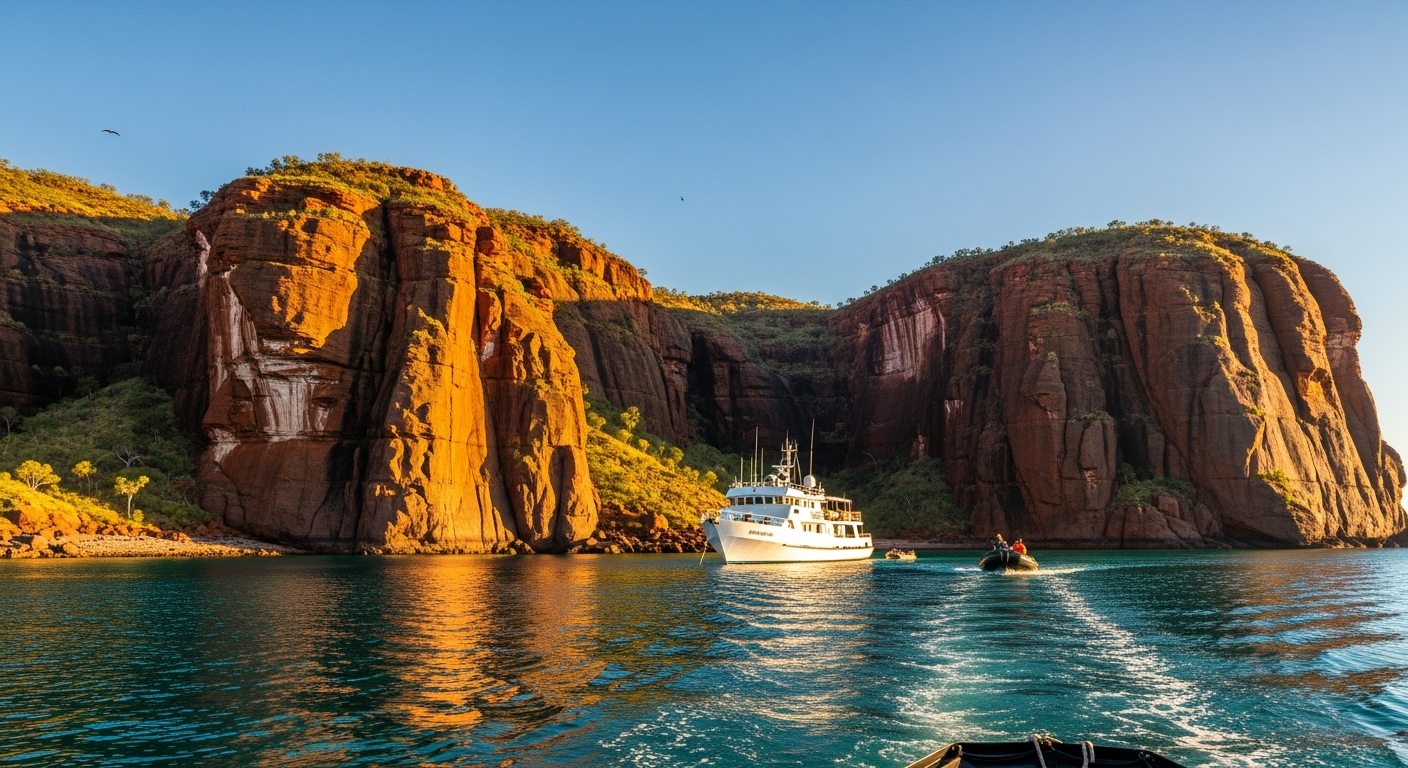
Small-ship expedition cruising trades buffets and crowds for wildlife, Zodiacs and a few dozen fellow travellers. For solo over-60s it can be expensive, but the pacing and company often suit us better than a big liner. Here is what to expect and what it really costs in AUD.
What is small-ship expedition cruising, really?
An expedition ship carries far fewer passengers than an ocean liner — often between 100 and 200, sometimes fewer. There is no casino, no theatre with feathered dancers, and no queue of three thousand people heading for the same shore. Instead the ship is built to reach places a big vessel cannot, using small inflatable boats called Zodiacs to land you on beaches, river mouths and ice.
The day is shaped by where you are, not by a fixed timetable. On a Kimberley voyage you might be up early for a Zodiac cruise to a waterfall, back aboard for lunch, then ashore again in the afternoon to see rock art. A naturalist or expedition leader explains what you are seeing, which I find adds far more than another round of trivia in the bar.
For a solo traveller this scale matters. On a small ship you learn names within a day or two, share a table with the same warm faces, and never feel lost in a crowd. That intimacy is the main reason I keep coming back to it.
How much does it cost in AUD?
Expedition cruising is not cheap, and I will not pretend otherwise. A seven to ten night Kimberley voyage with an operator like Coral Expeditions typically starts around A$9,900 per person twin share and climbs well past A$15,000 for a larger cabin. Antarctica voyages of ten to twelve nights generally begin near A$15,000 per person and rise sharply from there.
The fare usually includes all meals, most excursions, Zodiac landings and lectures. What it does not include is your flights to the departure port, travel insurance, and any pre or post cruise accommodation. Budget another A$1,500 to A$3,000 for those once you factor in Broome, Darwin or Ushuaia airfares from Melbourne.
For the Kimberley, flying into Broome or Darwin from Melbourne with Qantas or Virgin runs roughly A$500 to A$900 return if you book a few months ahead. Antarctica voyages departing Ushuaia involve long-haul flights to South America, so allow A$3,000 or more for that leg alone.
What about the single supplement?
This is where solo travellers feel the pinch. On most expedition ships, taking a cabin to yourself means paying a single supplement of 50 to 100 per cent on top of the twin-share fare. On a A$10,000 Kimberley fare that can add A$5,000 to A$10,000, which is a serious sum.
There are gentler options. Some operators release a small number of dedicated solo cabins, or run set departures with a reduced or waived supplement to fill the ship. These sell out early, so it pays to register your interest and ask to be told when they open. I have saved thousands simply by being flexible on dates.
A few smaller ships also offer a share-cabin matching service, pairing you with another same-sex solo traveller to split a twin. It is not for everyone, but it removes the supplement entirely and I have made good friends that way.
Will I be fit enough at my age?
Most over-60s manage expedition cruising comfortably, but you do need reasonable mobility. Getting in and out of a Zodiac involves stepping down onto a low platform and being helped across by crew, and some landings are onto rocks or soft sand. If your balance or knees are uncertain, this is the part to be honest with yourself about.
The good news is that nothing is compulsory. On every voyage I have done, people who preferred to stay aboard watched from the deck with a cup of tea and missed nothing of the company. Operators are also clear about how active each voyage is, so ask before you book.
If you have a heart condition, mobility aid or take regular medication, choose voyages within reach of medical help and tell the operator in advance. Antarctica in particular is remote, and good travel insurance that covers expedition cruising is not optional.
When should I go, and how far ahead should I book?
The Kimberley season runs roughly April to September during the dry, with the bigger waterfalls flowing best early in the season and the weather most settled mid-year. Antarctica voyages run the southern summer, November to March, with December and January offering long daylight and wildlife at its busiest.
Book well ahead. Solo cabins and reduced-supplement departures for the 2026 and 2027 seasons are already filling, and the best cabins go twelve to eighteen months out. Booking early also locks in lower lead-in fares before they rise.
Look out for early-bird discounts and onboard credit offers, which operators release periodically. These are genuine savings rather than invented urgency, and combined with a waived supplement they can make a real difference to a solo budget.
Is it worth it for a solo over-60 traveller?
If you measure value purely by nights and meals, no, a big ocean liner is cheaper. But that is not what you are buying here. You are buying access to places, time with people who become friends, and a pace that suits a body that no longer wants to march.
Many travellers come home from a Kimberley voyage feeling steadier and more themselves than from any package holiday. For a solo woman, the gentle structure of a small ship — knowing where you will be, who you will eat with, and that the crew has an eye out for you — takes the edge off travelling alone.
The honest advice is to save for the voyage you really want rather than settle for a cheaper one that disappoints. Do it once, do it properly, and chase the reduced-supplement departure to make the sums work.
Key takeaways
- Expect from about A$9,900 per person twin share for a Kimberley voyage and A$15,000 for Antarctica, before flights.
- Solo travellers usually face a 50 to 100 per cent single supplement, so hunt for dedicated solo cabins or reduced-supplement departures.
- Fares typically include meals, excursions and lectures, but not flights, insurance or pre and post cruise hotels.
- Reasonable mobility helps for Zodiac landings, but nothing is compulsory and crew assist at every step.
- Kimberley runs April to September; Antarctica runs the southern summer, November to March.
- Book twelve to eighteen months ahead to secure solo cabins and lead-in fares.
Where to look and book
Indicative prices only — always confirm with the operator before booking.
Frequently asked questions
Can I do an expedition cruise without flying overseas?
Yes. The Kimberley, between Broome and Darwin, is a domestic expedition entirely within Australia, reachable on a Qantas or Virgin flight from Melbourne for roughly A$500 to A$900 return.
Do I have to pay double as a solo traveller?
Not always. Many operators charge a single supplement of 50 to 100 per cent, but some offer dedicated solo cabins, reduced-supplement departures, or a share-cabin matching service that removes the supplement.
How fit do I need to be?
You need to step in and out of a Zodiac with crew assistance and manage some uneven ground. Anyone with good general mobility usually copes well, and all landings are optional.
Is travel insurance essential?
Yes, and you must check it specifically covers expedition cruising and remote-area medical evacuation, particularly for Antarctica where help is far away.
When should I book?
Twelve to eighteen months ahead for the best cabins and the limited solo and reduced-supplement allocations, which tend to sell out early.
Got a tip, a price update or a story from this route? The community would love to hear it.
Share your views on our Facebook page— Seniors and Solo Traveller Stories
More cruises
Can You Cruise Round Australia and the South Pacific Without Boarding a Plane?
Princess Cruises sails from Australian ports including Melbourne and Sydney, which means over-60s in Victoria can join…
Cruising from Melbourne and Sydney: A Couple's Honest Guide to Sailing After 60
Ocean cruises departing Australian ports remain one of the easiest ways for over-60 travellers to see new places witho…
Is a Coral Expeditions Kimberley Cruise the Right Pace for Over-60 Travellers?
Coral Expeditions runs small-ship expedition cruises along Western Australia's Kimberley coast, carrying far fewer pas…